
Driveway Repair or Replacement in Canberra: Which Is Right for You?
A cracked or tired driveway doesn’t always mean starting from scratch, and in Canberra, where reactive clay soils and frosty winters put driveways under real stress, knowing the difference can save you thousands. The rule of thumb: if the damage is minor, surface-level and the driveway is still structurally sound, a repair is the smart, cost-effective fix. If the damage is widespread, the base or drainage has failed, or the driveway is near the end of its life, replacement is the better long-term spend. Below we cover how to tell which camp your driveway falls into, why Canberra and Queanbeyan conditions cause so much of the damage, and how the two options compare on cost and lifespan.
Repair or replace? At a glance
| Consider… | Repair | Replace |
|---|---|---|
| Extent of damage | Minor, isolated to one area | Widespread (roughly 25–30%+ of the surface) |
| Crack type | Hairline or single, stable cracks | Interconnected ‘map’ or ‘alligator’ cracking |
| Underlying cause | Surface wear and tear | Base, drainage or structural failure |
| Driveway age | Well within its 25–30 year life | Near or past the end of its life |
| Upfront cost | Lower | Higher |
| Lifespan gained | Shorter — buys you time | ~30 years from a new slab |
When to repair your driveway
Repair is usually the right call when the driveway is fundamentally structually sound and the problem is cosmetic or contained.
Tell-tale signs a repair will do the job:
Hairline or single cracks that aren’t spreading or lifting at the edges.
Minor surface flaking or ‘spalling’ in a small area, rather than across the whole slab.
A localised trip hazard or a single sunken section that can be lifted or patched.
Small chips, potholes or worn patches on an otherwise solid driveway.
A driveway that’s comfortably within its expected 25–30 year lifespan.
In these cases, repairing costs a fraction of a full replacement and can add years of life. Left too long, though, small cracks let water reach the base, so acting early is what keeps a repair a repair.
When to replace your driveway
Replacement becomes the smarter option when the damage is structural or so widespread that patching is just good money spent badly. Signs it’s time to replace include:
Interconnected cracks that look like scales or a road map, covering much of the surface.
Large sections that have sunk, lifted or heaved, which is usually a sign the base or drainage beneath has failed.
Damage across roughly 25–30% or more of the driveway.
A driveway at or past the 25–30 year mark, where repairs buy less time than they cost.
Repeated repairs that keep failing in the same spots.
Persistent drainage or pooling problems that undermine the slab from below.
When the base is the problem, no surface repair will hold and the only lasting fix is to remove the old slab, correct the base and drainage, and pour new. It costs more upfront but resets the clock for another few decades. If a replacement extends to the vehicle crossing at the street, that section needs council approval (TCCS in the ACT or a Section 138 approval through QPRC in NSW) which we handle as part of the job.
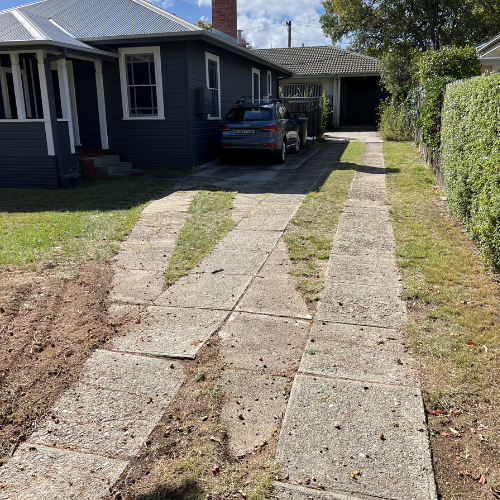
A full driveway replacement
A concrete driveway in Ainslie, that we diagnosed as a full replacement.
Why Canberra and Queanbeyan driveways crack and fail
Local conditions are often the real reason a driveway ages the way it does and understanding them helps you judge whether a repair will actually hold. Around Canberra and the Queanbeyan region, three factors do most of the damage.
Reactive clay soils
Much of the Canberra region sits on reactive clay that swells when wet and shrinks when dry. That constant ground movement lifts, drops and cracks concrete from below — and it’s a leading cause of the sunken sections and widespread cracking that point to replacement rather than repair.
Cold, frosty winters
Canberra has some of the coldest winters of any Australian capital. Repeated freeze-thaw cycles work into existing cracks and surface flaws, widening them over time and speeding up spalling on exposed slabs. A small crack ignored before winter is often a bigger one by spring.
Hot, dry summers
At the other extreme, hot dry summers pull moisture from the ground, shrinking those clay soils and moving the base again. This annual swell-and-shrink cycle is why local driveways can crack even when they were well built, and why correcting drainage and base issues, not just the surface, is central to a lasting result.
If your driveway’s damage traces back to ground movement or drainage rather than simple surface wear, that’s a strong signal it’s a replacement with a corrected base, not a patch that will crack again next season.
How the costs compare
Repairs are always cheaper upfront than a full replacement and often a small fraction of the cost for minor crack filling or patching. But upfront price isn’t the whole picture. Repairing a driveway that’s fundamentally failing tends to be money wasted: you pay again and again as new cracks appear, and still end up replacing it. The honest way to compare is cost per year of life gained. A repair that buys two years on a worn-out slab is poor value next to a replacement that lasts thirty.
Lifespan and long-term value
A properly built new driveway lasts around 30 years with basic care. A repair by contrast, typically restores far less, often about half that, or less, depending on what’s underneath. If your driveway is young and the damage is cosmetic, a repair gets you excellent value. If it’s old and failing, replacement almost always wins on a whole-of-life basis.
How we assess your driveway
The right answer depends on what’s happening beneath the surface, which is why we always assess on site rather than guess from a photo you send. We work right across Canberra and the Queanbeyan region, from established inner-north and Woden suburbs where driveways are reaching the end of their life, to newer estates in Gungahlin and Googong dealing with settling ground.
We look at the extent and type of cracking, whether the base or drainage has failed, the driveway’s age and how it’s moving, then give you an honest recommendation; repair or replace, with the reasoning behind it. Sometimes that means talking you out of a replacement you don’t need; sometimes it means being straight that a repair won’t last. Either way you get a clear, itemised quote for the option that genuinely suits your driveway.
Quick decision checklist
| Lean towards a repair if… | Lean towards a replacement if… |
|---|---|
| ✓ Damage is minor and limited to one area | ✓ Cracking is widespread or interconnected |
| ✓ Cracks are hairline or single and stable | ✓ Sections have sunk, lifted or move underfoot |
| ✓ The base feels solid — no sinking or rocking | ✓ You’ve repaired it before and it keeps failing |
| ✓ The driveway is well within its expected lifespan | ✓ It’s 25–30 years old or older |
Frequently asked questions
Why does my Canberra driveway keep cracking?
Usually it’s the ground beneath, not the concrete itself. Canberra’s reactive clay soils swell and shrink with the seasons, and frosty winters widen existing cracks, both move the base and stress the slab. If cracking keeps coming back, the base or drainage typically needs correcting, which is a replacement issue rather than a repair.
Is it cheaper to repair or replace a driveway?
Repairs are cheaper upfront, often a small fraction of a replacement. But on an old or failing driveway, repeated repairs can cost more over time than replacing once. The best-value choice depends on the driveway’s condition and age, which is why an on-site assessment matters.
When should I replace rather than repair my driveway?
Replace when damage is widespread (around 25–30%+ of the surface), when the base or drainage has failed, when sections are sinking or heaving, or when the driveway is near or past its 25–30 year lifespan. Isolated, surface-level damage on a sound slab is usually a repair.
How long does a driveway repair last?
It depends on the repair and what’s underneath, but repairs generally last around half as long as a new driveway; great value on a sound slab, poor value on a failing one.
What causes driveways to crack and fail?
Common causes are a poorly prepared or moving base, inadequate drainage, tree roots, ground movement, and simple age. Widespread cracking usually points to a base problem, which is a replacement issue rather than a repair one.
Not sure whether to repair or replace? We’ll tell you straight.
We offer new driveways, repairs and full replacements across Canberra and the Queanbeyan (QPRC) region.
Book a free on-site assessment and we’ll recommend the option that’s genuinely right for your driveway, with no upsell.