
Concrete Section Repair: The Middle Option Between Patching and a New Driveway
Most homeowners think about a damaged driveway as a two-way choice — patch it, or replace the lot. There's a third option that often suits better than either, and it's the one people rarely ask for by name: replacing just the failed section, properly, down to the base.
A patch treats the surface. A full replacement starts again. A section repair sits between them: the damaged area is cut out and rebuilt from the sub-base up, while the sound concrete around it stays where it is. Done well, the repaired section outlasts the driveway it sits in.
The catch is that a section repair only works when the surrounding slab genuinely is sound. Getting that judgement wrong is how people end up paying twice.
Repair or replace? At a glance
| Consider… | Repair | Replace |
|---|---|---|
| Extent of damage | Minor, isolated to one area | Widespread (roughly 25–30%+ of the surface) |
| Crack type | Hairline or single, stable cracks | Interconnected ‘map’ or ‘alligator’ cracking |
| Underlying cause | Surface wear and tear | Base, drainage or structural failure |
| Driveway age | Well within its 25–30 year life | Near or past the end of its life |
| Upfront cost | Lower | Higher |
| Lifespan gained | Shorter — buys you time | ~30 years from a new slab |
When a Section Repair Is the Right Call
Repair is usually the right call when the driveway is fundamentally structually sound and the problem is cosmetic or contained.
Tell-tale signs a repair will do the job:
Hairline or single cracks that aren’t spreading or lifting at the edges.
Minor surface flaking or ‘spalling’ in a small area, rather than across the whole slab.
A localised trip hazard or a single sunken section that can be lifted or patched.
Small chips, potholes or worn patches on an otherwise solid driveway.
A driveway that’s comfortably within its expected 25–30 year lifespan.
In these cases, repairing costs a fraction of a full replacement and can add years of life. Left too long, though, small cracks let water reach the base, so acting early is what keeps a repair a repair.
When It Isn't
Be sceptical of a section repair when:
Cracking is interconnected or appears in several unrelated places
You've already repaired the same driveway more than once
Sections sink or lift across a wide area, which usually points to a drainage or ground-movement problem affecting the whole slab
The driveway is near or past the 25–30 year mark, where the sound concrete isn't sound for much longer either
The damage runs across the vehicle crossing at the street, where council requirements come into play
In those cases the honest answer is full replacement, and a section repair is money spent on a driveway that's going to be replaced anyway.
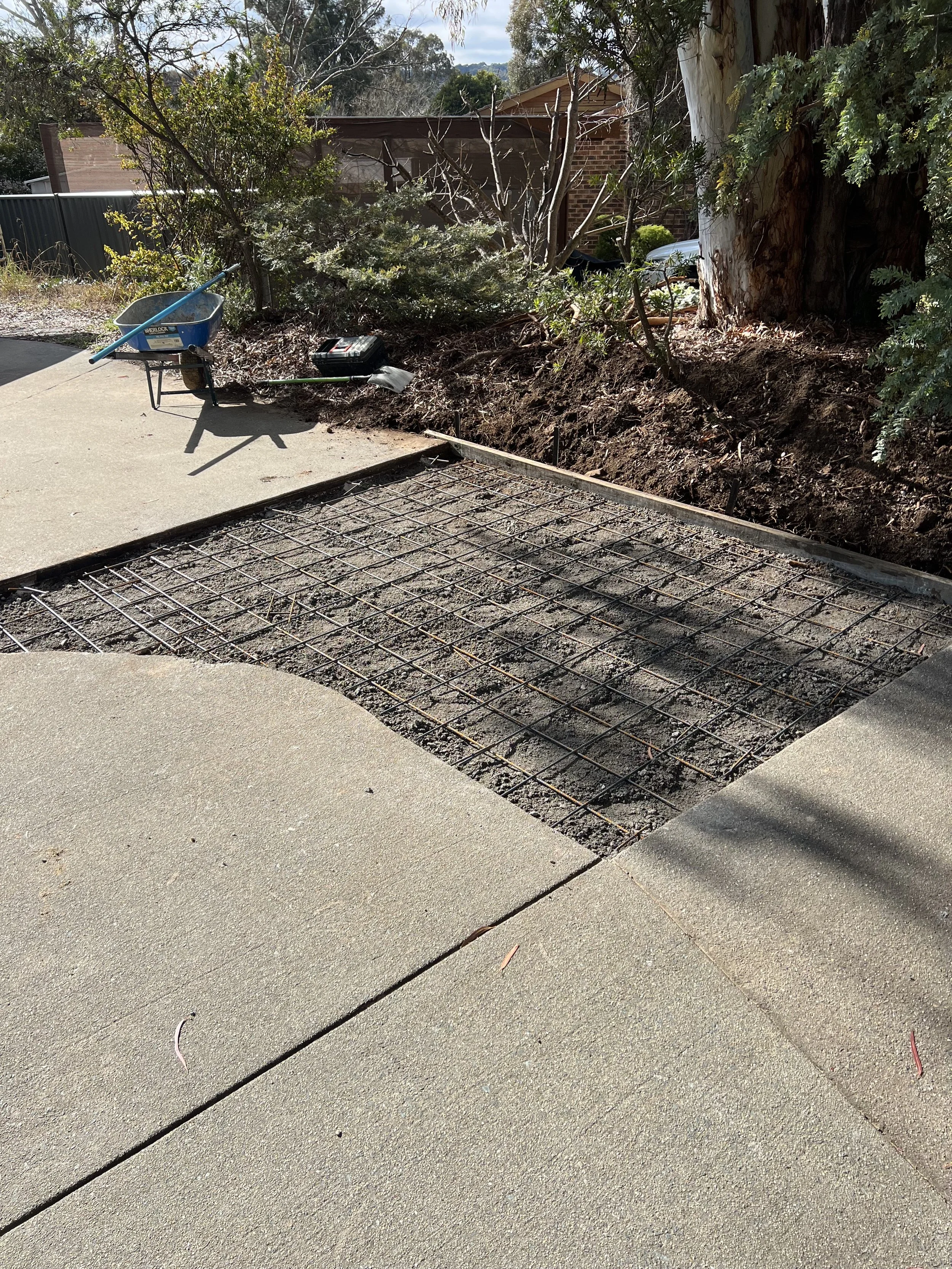
A driveway Repair
A concrete driveway repair in Oxley, that we diagnosed as a section repair.
What a Proper Section Repair Involves
The difference between a section repair and an expensive patch is what happens below the surface. A repair that only replaces concrete replaces the symptom.
1. Cut a clean edge. The damaged section is isolated with a straight, square cut into sound concrete. Ragged break-out lines make weak joins and visible scars.
2. Remove the failed slab. Where access is tight or landscaping is close, this is done by hand rather than with machinery.
3. Inspect what's underneath. This is the step that determines whether the repair lasts. Failed concrete almost always sits above failed base — voided, eroded, or never properly compacted.
4. Rebuild the base. Failed material is excavated out and replaced with new road base — DGB20 is the standard specification — compacted to correct levels and falls.
5. Reinforce. New steel mesh, typically SL82, goes through the repaired section so the new concrete carries vehicle load as a slab rather than a plug.
6. Repour and tie in. New concrete is poured to match the existing thickness and finish, and levelled flush with the surrounding driveway.
Skip steps 3 and 4 and you have a patch. It will look correct for a season, then fail in the same place for the same reason.
Why Base Failure Is So Common in Canberra
Section repairs come up often here, and the reason is under the concrete rather than in it.
The Canberra region's reactive clay soils swell when wet and shrink when dry, moving the ground beneath a slab through every seasonal cycle. Water finding its way through a crack, along a poorly drained edge, or off a downpipe will wash fines out of the base over years — leaving a void the slab spans until it can't. Frosty winters then work the existing cracks wider, and hot dry summers shrink the clay back again.
The result is a very local pattern of failure: one area goes while the rest of the driveway stays perfectly serviceable. That's precisely the situation a section repair is built for — and precisely why the base has to be rebuilt rather than covered over.Lifespan and long-term value
A properly built new driveway lasts around 30 years with basic care. A repair by contrast, typically restores far less, often about half that, or less, depending on what’s underneath. If your driveway is young and the damage is cosmetic, a repair gets you excellent value. If it’s old and failing, replacement almost always wins on a whole-of-life basis.
Will the Repair Match?
New concrete is lighter than aged concrete. There's no way around it, and any contractor promising an invisible repair on day one is overselling.
What you should expect instead: a straight, deliberate join rather than a ragged one; a section poured to the same level and finish as the concrete around it; and colour that tones down over the following months as the new slab weathers. Within a year the repair reads as part of the driveway rather than a patch on it.
If matching matters more than anything — a decorative or exposed aggregate driveway, for instance — that's worth raising at assessment, because it can shift the calculation toward replacement.
Frequently asked questions
Can you replace just part of a concrete driveway?
Yes. Where the surrounding slab is structurally sound, the failed section can be cut out and rebuilt from the base up, leaving the rest in place. It's substantially cheaper than a full replacement and, where the diagnosis is right, just as durable in the repaired area.
Is a section repair the same as a patch?
No. A patch fills or covers damage at the surface. A section repair removes the failed concrete, rebuilds the base underneath, adds new reinforcement, and repours. The distinction is what happens below the slab, which is usually where the problem started.
How do I know if my base has failed?
You often can't tell for certain until the concrete comes up, but the signs are suggestive: a section that rocks or moves underfoot, an edge that has lifted or dropped relative to its neighbours, cracking that keeps returning in the same spot, or water pooling nearby. Hollow-sounding concrete is another indicator.
How long does a section repair take?
Most are completed on site in a day or two, depending on size and access. The new concrete then needs curing time before it can take vehicle traffic — expect to keep off it for several days.
Will one section failing mean the rest follows?
Not necessarily. Localised base failure is common and often has a localised cause — a drainage issue at one edge, or one poorly prepared area. That said, if the same conditions apply across the whole driveway, more sections may follow. That's part of what an on-site assessment establishes.
Do I need council approval for a section repair?
Not for repairs within your property. If the work extends to the vehicle crossing at the street, approval is required — through TCCS in the ACT, or a Section 138 approval through QPRC in NSW. We handle that as part of the project.
Not sure whether to repair or replace? We’ll tell you straight.
We offer new driveways, repairs and full replacements across Canberra and the Queanbeyan (QPRC) region.
Book a free on-site assessment and we’ll recommend the option that’s genuinely right for your driveway, with no upsell.